Annual Meeting 2026 1st Announcement CfP

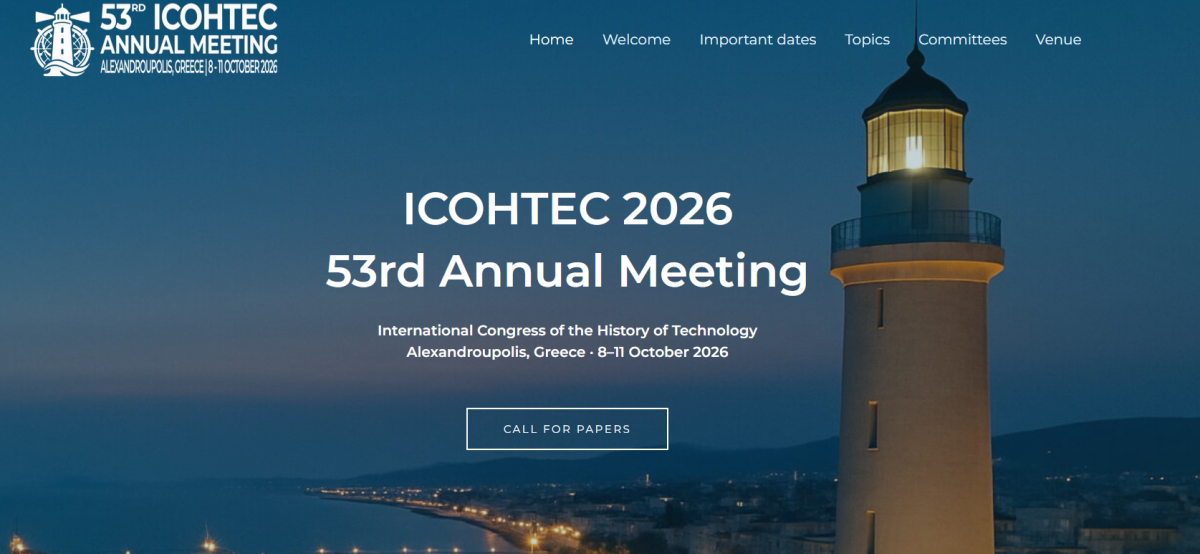
53rd ICOHTEC Annual Meeting – First Announcement

Alexandroupolis, Greece | 8–11 October 2026
Theme: Engaging the History of Technology: Bridging Disciplines and Perspectives for Global Challenges

The International Committee for the History of Technology (ICOHTEC) announces its 53rd Annual Meeting, hosted by the Democritus University of Thrace, in collaboration with the Laboratory of Technologies, Research & Applications in Education and the Ethnological Museum of Thrace.

The 2026 conference explores how the history of technology can illuminate today’s global challenges—climate change, environmental injustice, political polarization, and artificial intelligence—by connecting historical, cultural, ethical, and technological perspectives.

Scientific Themes

Contributions may address topics such as:

  • The movement of technologies, experts, and knowledge across borders.

  • Methodological and interdisciplinary innovations in the history of technology.

  • Intersections with social, cultural, economic, environmental, and political history.

  • Museum practices, material and intangible heritage, and public engagement.

Submission Formats

  • Paper presentations (up to 350 words)

  • Panel sessions (400-word panel abstract + later individual abstracts)

  • Roundtables (description of topic + participants’ bios)

  • Graduate and early-career opportunities, including lightning talks, mentoring, and workshops

Important Dates

  • Abstract submission opens: 15 December 2025

  • Deadline: 31 January 2026

More information

Website: https://icohtec2026.hs.duth.gr


Email: icohtec2026@gmail.com


Official and extended Call for Paper:

ICOHTEC 2026 conference_Greece_1st announcement

Railways 200

I share to all Icohtec friends and colleagues this email of Mike Esbester about an interesting initiative at JTH (Journal of Trasport History) to celebrate the 200 years anniversary of the inauguration of the first steam-hauled passenger railways journey:

Dear all,
Hope you’re well. Earlier in the year we put together a virtual collection of 17 JTH articles, focused on Britain’s railways, marking ‘Railway 200’, the 200th anniversary of the first steam-hauled passenger railway journey on the Stockton and Darlington Railway.
We’ve worked with Sage to give free access to the collection over two periods – the second of which starts tomorrow, and runs 3-10 November. This coincides with the T2M conference.
Do please share widely, particularly in this period when they’re free to access – we want people to read them! We’ve tried to take a broad view of the articles – whilst focusing on British railways, we’ve included international connections, for example, and considered whose voices we hear in the articles.
If you are sharing on social media and other platforms, feel free to use #Railway200, which is being widely used at the moment. Also, do tag the JTH in on any channels you use where the JTH has a presence:
All the best, and thanks in advance,
Mike

Call for submission to the Icohtec Newsletter

The Icohtect Newsletter welcomes submissions from scholars and practitioners in relevant fields. Contributions may include event announcements, descriptions of ongoing projects, reflections, or news items of interest. We also invite short blog-style essays (up to 800 words). The aim of the Newsletter is to keep members and affiliates informed about current developments and emerging discussions in the field.
Submissions should be sent to:
Anna Batzeli
Newsletter Editor
abatzeli@he.duth.gr

Invitation to an Online Lecture

12 November 2025, 17.30 CET


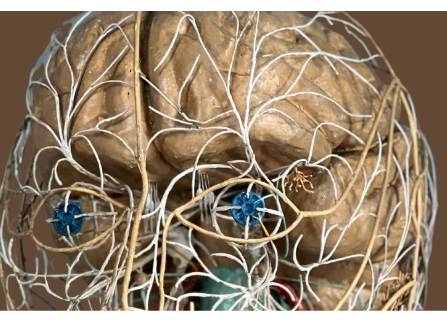
Polio Vaccination in Mexico, 1955 – 1975


Dr. Deyanira Cuanal Cano, Universidad Autónoma Metropolitana, Mexico City


In this lecture, Deyanira Cuanal Cano analyzes Mexico’s involvement in the production of polio vaccines in the mid-20th century. It focuses on three key aeras:

  • The transnational and international agreements that enabled the establishment and consolidation of its laboratories, as well as local conditions, from 1955 to 1975,
  • The tensions that arose from the use of biological materials that derived from viruses, monkeys, and humans,
  • The instability of some vaccine preparations within the laboratories.

Finally, the lecture investigates uncertainties that arose from fighting against polio through using vaccines, ranging from vaccine accidents to a lack of control how certain viruses behave in case of contact with various biological agents.


Zoom link of the event: https://kit-lecture.zoom-x.de/j/6884631281?pwd=R3ZwaXVvQWhEaG5MTmlrdytTUXFPUT09


Please contact: stefan.poser@kit.edu